An Oasis in the Bad Lands (1905)
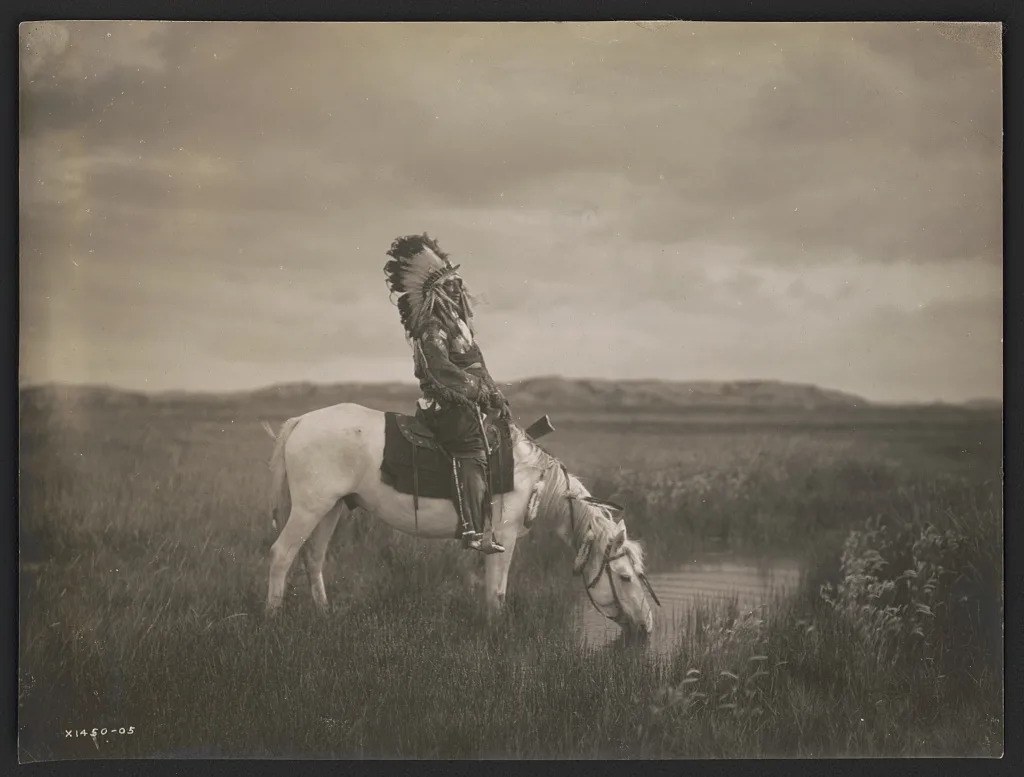
The Oglala Lakota sub-chief Red Hawk, in a feathered war bonnet, sits on a pale horse as it drinks from a small pool in the Badlands. Copyrighted by Edward S. Curtis in 1905 and published as plate 80 of The North American Indian, it is one of his most admired images of the northern plains. This archive holds the Library of Congress gelatin silver print.
- Date
- 1905 (copyright 1905; Curtis negative no. 1450-05)
- Sitter
- Red Hawk, Oglala Lakota sub-chief, born 1854 according to Curtis
- Place
- The Badlands; Curtis's caption says South Dakota, the Library of Congress record says North Dakota
- Published
- The North American Indian, Portfolio III, plate 80 (1908)
- This archive's print
- Gelatin silver print, 15.2 x 20.2 cm, Library of Congress Edward S. Curtis Collection
- Also known as
- An Oasis in the Badlands; An Oasis in the Bad Lands—Oglala; Red Hawk
What the photograph shows
A rider in a full eagle-feather war bonnet sits on a light-colored horse that has lowered its head to drink from a small pool. Horse and rider are seen side-on, set against a wide band of grassland, low hills and a heavy, clouded sky that takes up nearly half of the frame. Reeds and brush grow around the water in the foreground. The single figure in an open landscape, and the stillness of the drinking horse, give the picture the calm suggested by its title.
Curtis's caption for plate 80 names the rider as the sub-chief Red Hawk and says the picture was made in the heart of the Bad Lands of South Dakota.
Who Red Hawk was
Curtis printed a short biography of Red Hawk with the plate, based on what Red Hawk told the project. According to it, he was born in 1854, went on his first war party in 1865 under Crazy Horse, counted his first coup against a party of Blackfeet, and fought in about twenty battles against U.S. troops and against other nations, including the Custer fight of 1876, known today as the Battle of the Little Bighorn. Curtis wrote elsewhere that Red Hawk's memory of that battle was unusually clear and detailed, and that he persuaded Red Hawk to visit the battlefield with him.
The war bonnet he wears was, as Curtis's text explains, a sign of honors earned in war and not something any man could wear. These details come from Curtis's book rather than from an independent biography, and they reflect what Curtis chose to record.
How it was made and published
Curtis copyrighted the photograph in 1905 under his negative number 1450-05. It appeared in 1908 as plate 80 of the third portfolio of The North American Indian, with Red Hawk's biographical sketch printed in the caption and continued in the text volume.
The sources do not describe this particular sitting, but Curtis's portraits of plains warriors were posed. The Library of Congress essay by Gerald Vizenor notes that Curtis paid people to pose, chose regalia and ornaments, and made images such as Oglala War-Party showing men as they had appeared in the days of intertribal warfare, at a time when many Lakota people were struggling on reservations. Nothing in the sources says Red Hawk did not own or have the right to wear his regalia, but the picture should be read as a composed portrait rather than a scene caught by chance.
Why it became famous
An Oasis in the Bad Lands combines the elements that made his work popular: a named warrior who fought at the Little Bighorn, full ceremonial dress, and a broad landscape treated with soft Pictorialist tones. This very print was exhibited in The Illusion of the American Frontier at the Museo Thyssen-Bornemisza in Madrid in 2015–2016. That exhibition's title names the question that hangs over the picture: it is beautiful, and it is also a carefully composed vision of a West that was already changing.
What to look for
Notice how low Curtis set the horizon. The land occupies only the lower half of the frame, and a band of distant hills runs almost straight across it, so that horse and rider stand up against the sky. The pale horse is the brightest shape in the picture, and its lowered head leads the eye down to the small pool and its reflection in the foreground.
Look too at the war bonnet, whose feathers rise above Red Hawk's head and trail down his back, and at how he sits still while the horse drinks. There is no action in the picture, no other figures, and no sign of a road, fence or building. That emptiness is part of the composition's appeal, and part of what makes it a constructed image of the plains rather than a record of how the Badlands looked to the people living near them in 1905. In the lower left corner of this print you can read Curtis's negative number, which matches the Library's record.
The version in this archive
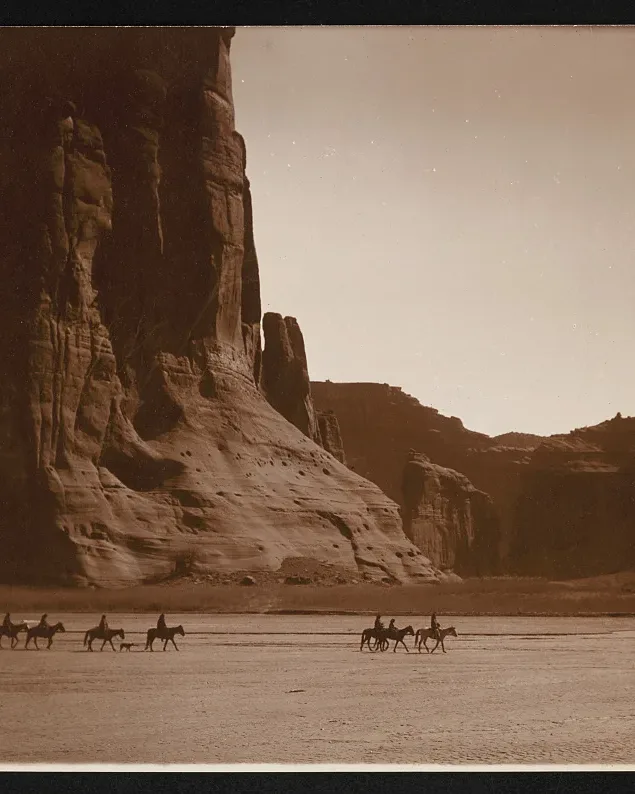
This archive's image is the Library of Congress gelatin silver print, 15.2 by 20.2 centimeters, with Curtis's negative number written in the lower left corner. It is a photographic print made from the negative, not the published photogravure. The Library's record places the scene in the Badlands of North Dakota, while Curtis's own caption says South Dakota; we follow the caption, and the difference is worth knowing if you compare records. The archive also holds an unrelated Curtis photograph titled An oasis, showing Navajo riders at water, which should not be confused with this one.
Frequently asked questions
Who is the man in An Oasis in the Badlands?
Curtis identified him as Red Hawk, an Oglala Lakota sub-chief born in 1854 who, according to Curtis's text, fought at the Battle of the Little Bighorn in 1876.
Where was An Oasis in the Badlands taken?
Curtis's caption says it was made in the heart of the Bad Lands of South Dakota. The Library of Congress record for its print says North Dakota, so the sources disagree.
When was An Oasis in the Badlands made?
It was copyrighted in 1905 and published in 1908 as plate 80 in the third portfolio of The North American Indian.
Sources
- An oasis in the Badlands, catalog record (Library of Congress)
- An Oasis in the Bad Lands—Oglala, plate 80 caption (The North American Indian, Göttingen State and University Library digital edition)
- An Oasis in the Bad Lands, exhibit guide (University of Pittsburgh Library System)
- Gerald Vizenor, Edward Curtis: Pictorialist and Ethnographic Adventurist (Library of Congress American Memory essay, 2000; archived copy)