The Vanishing Race—Navaho (1904)
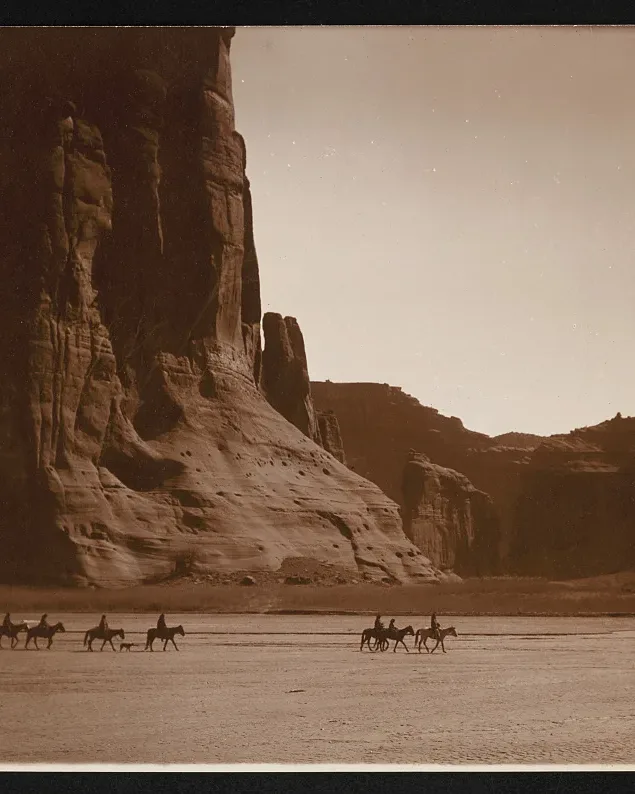
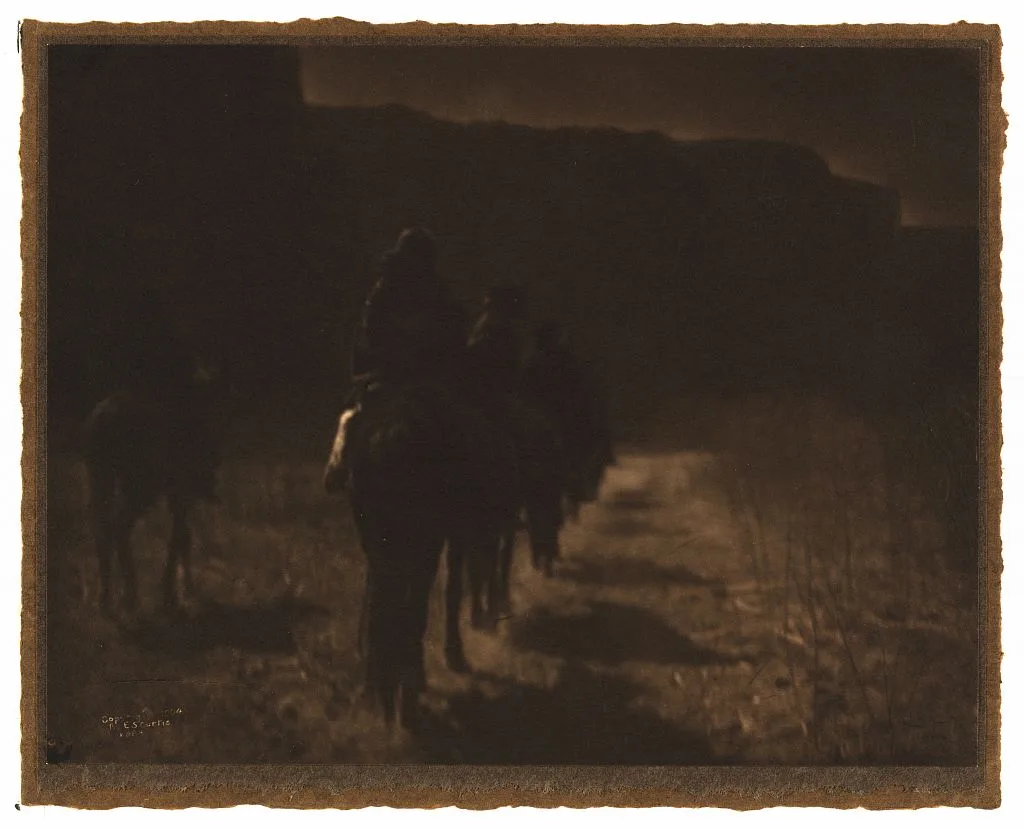
A line of Navajo riders moves away from the camera into a dark canyon, one of them turning to look back. Curtis copyrighted the photograph in 1904 and chose it as plate 1 of The North American Indian because, he wrote, it expressed the thought behind the whole work: that Native peoples were passing into an unknown future. It is his most quoted image and the clearest statement of the idea historians now call the myth of the vanishing race. This archive holds both a platinum print and the published photogravure.
- Date
- 1904 (copyright 1904; Curtis negative no. 984)
- Published
- The North American Indian, Portfolio I, plate 1 (1907)
- Original title
- The Vanishing Race—Navaho (Curtis's spelling)
- This archive's prints
- Platinum print, sepia toned, 6 1/4 x 8 in. (15.7 x 20.3 cm), and the portfolio photogravure printed by John Andrew & Son, Boston; both Library of Congress
- Provenance of the platinum print
- Louise Imogen Guiney Collection, given to the Library of Congress in 1934
- Also known as
- The Vanishing Race; The Vanishing Race, Navajo; Vanishing Race Edward Curtis
Curtis's own explanation
Few photographs come with so explicit a statement of intent. In the caption for plate 1 of the first portfolio, Curtis wrote: "The thought which this picture is meant to convey is that the Indians as a race, already shorn of their tribal strength and stripped of their primitive dress, are passing into the darkness of a unknown future." He added that because the picture expressed so much of the thought that inspired the entire work, he had chosen it as the first of the series.
The image therefore works as a kind of title page for The North American Indian, the twenty-volume publication issued between 1907 and 1930. The scholar Mick Gidley calls it the keynote picture of the whole project.
What the photograph shows
A column of riders on horseback moves away from the viewer along a track, heading toward a dark wall of cliffs. Their backs are to the camera and their faces are mostly hidden; Gidley describes the scene as some Navajos entering a canyon, with one head turned to look back. The foreground is in deep shadow, and the only strong light falls on the path ahead and the sky over the canyon rim, so the riders seem to move out of the light rather than toward it.
The riders are not named in Curtis's caption or in the Library of Congress records. The Library describes the image simply as Navajos on horseback riding away from the photographer.
The myth behind the title
The idea that Native Americans were a vanishing race was widespread when Curtis made this picture. In an essay written for the Library of Congress, the historian David R. M. Beck explains that it drew on the belief that the frontier had closed and on Social Darwinist theories of competing races, and that it was reinforced by catastrophic population loss from war and disease and by the federal policy of forced assimilation pursued from the late 1880s to the mid-1930s. Wild West shows, world's fairs, museums and advertising all repeated the theme.
Beck's conclusion is that Native nations did not vanish, as peoples or as political communities, and that Curtis's photographs helped keep the myth alive in American culture. The writer Gerald Vizenor, also writing for the Library, describes the picture as a column of natives lost in the shadows, a sentimental evanescence, and stresses that Curtis composed it as an image of absence at a time when Native people were very much present, as teachers and doctors as well as on reservations; he names Luther Standing Bear and Charles Eastman.
Why it became famous
Its fame comes from its position and its clarity. As the first plate in the first portfolio, it was the image every subscriber saw before any other, and its message needs no caption. It has since become the picture most often used to sum up Curtis's project, both by admirers who see it as a lament and by critics who see it as a statement of a mistaken, and convenient, belief. Gidley notes that Curtis's views were contradictory: he could judge Native cultures harshly, support assimilation, and at the same time mourn what he thought was being lost, and later in life he wrote with real anger about government policy.
What to look for
Follow the path. It runs from the lower edge of the frame toward the cliffs, and the riders strung along it grow smaller and fainter as they go, until the last figures almost merge with the shadow. Look for the rider whose head is turned back toward the camera, the detail Gidley singles out, and for the horse partly cut off at the left edge, which makes the column feel as if it continues beyond the frame.
Then look at where the light is. The brightest areas are the strip of sky above the canyon wall and the sunlit ground beside the trail ahead; the riders themselves are mostly in silhouette. Curtis did not need to show faces, clothing or individual people to make his point, and that absence is itself part of what critics object to: the people in the picture become a symbol rather than a community with names and a future.
The versions in this archive
This archive holds two Library of Congress versions of the image. The main one is a platinum print, toned sepia, measuring 6 1/4 by 8 inches, with the notation "Copyright 1904 by E.S. Curtis, x984" in the lower left corner; it came to the Library in 1934 with the collection of the poet Louise Imogen Guiney.
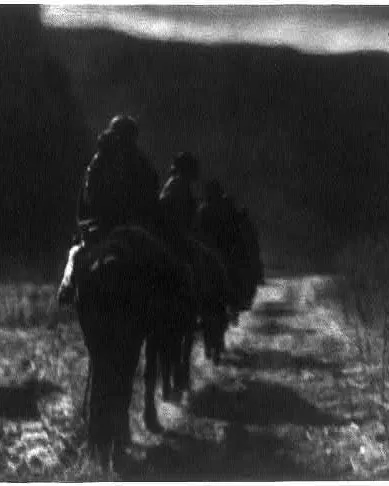
The second is the photogravure published as plate 1 of Portfolio I, produced in Boston by John Andrew & Son. Comparing the two shows the same negative in two different printing processes, one a photograph and one an ink print.
Other versions in the archive
Frequently asked questions
What does The Vanishing Race by Edward Curtis mean?
Curtis said the picture was meant to convey that Native peoples, already weakened, were passing into the darkness of an unknown future. Historians now describe that idea as a myth: Native nations, including the Navajo Nation shown here, did not vanish.
When was The Vanishing Race taken?
The photograph was copyrighted in 1904 and published in 1907 as plate 1 of the first portfolio of The North American Indian.
Who is in The Vanishing Race photograph?
Navajo riders on horseback, seen from behind as they move toward a canyon. Neither Curtis nor the Library of Congress records name the individuals.
Why is The Vanishing Race the first plate in The North American Indian?
Curtis wrote that he chose it as the first of the series because it expressed so much of the thought that inspired the entire work.
Sources
- The vanishing race--Navaho, platinum print, catalog record (Library of Congress)
- The vanishing race--Navaho, photogravure, catalog record (Library of Congress)
- The Vanishing Race—Navaho, plate 1 caption (The North American Indian, Göttingen State and University Library digital edition)
- David R. M. Beck, The Myth of the Vanishing Race (Library of Congress American Memory essay, 2001; archived copy)
- Gerald Vizenor, Edward Curtis: Pictorialist and Ethnographic Adventurist (Library of Congress American Memory essay, 2000; archived copy)
- Mick Gidley, Edward S. Curtis (1868-1952) and The North American Indian (Library of Congress American Memory essay, 2001; archived copy)