Cañon de Chelly—Navaho (1904)
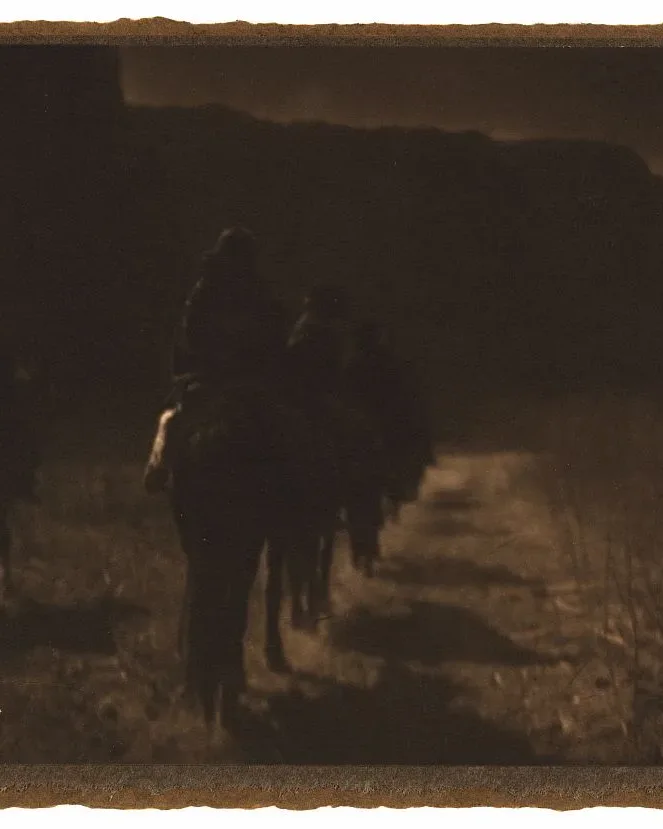
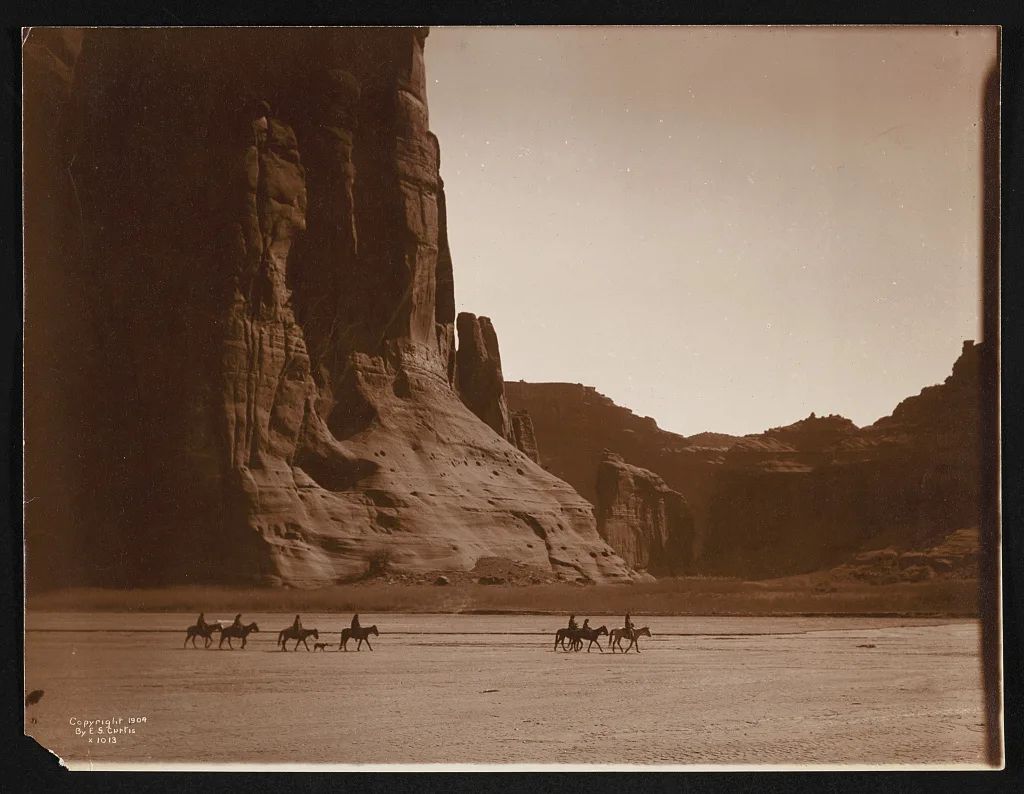
Seven riders on horseback, followed by a dog, cross the sandy floor of Canyon de Chelly in northeastern Arizona while a sheer sandstone wall rises above them. Copyrighted by Edward S. Curtis in 1904 and published as plate 28 in the first portfolio of The North American Indian, it is one of the most reproduced photographs he ever made. This archive holds the Library of Congress's copyright-era print.
- Date
- Photographed by 1904 (copyright 1904; Curtis negative no. 1013)
- Place
- Canyon de Chelly, northeastern Arizona, on Navajo Nation land
- Published
- The North American Indian, Portfolio I, plate 28 (caption dated 1907)
- Original title
- Cañon de Chelly—Navaho (Curtis used the older spellings Cañon and Navaho)
- This archive's print
- Photographic print, Library of Congress Edward S. Curtis Collection (LOT 12311), catalogued as [Navajo riders in Canyon de Chelly]
- Also known as
- Canyon de Chelly; Canyon de Chelly, Navajo; Navajo riders in Canyon de Chelly; Edward Curtis Canyon de Chelly
The place
Canyon de Chelly is a system of deep sandstone canyons in northeastern Arizona. Curtis's own caption, written for the 1907 portfolio, calls it a wonderfully scenic spot "in the heart of the Navaho country" and "one of their strongholds," and notes the ruins of earlier villages perched in niches along its walls. Elsewhere in the first volume he described it as the garden spot of the reservation, with small farms and peach orchards watered by seasonal floods.
Those ruins belong to an older story. According to the National Park Service, Ancestral Puebloan people built pit houses and later alcove dwellings in the canyons and lived there until the mid-1300s, and the archaeological record spans more than 4,000 years. Canyon de Chelly National Monument was authorized in 1931. Its roughly 84,000 acres lie on Navajo Nation land and are managed in partnership by the Park Service and the Navajo Nation, and about 40 Navajo families still live, farm and raise livestock inside the park boundaries.
What the photograph shows
The picture is built on a simple contrast of scale. On the left, a towering cliff face fills nearly half the frame, its base lit and its upper wall in shadow. To the right the canyon opens out toward lower, distant walls under a pale sky. Across the flat, bright floor of the canyon move seven riders, four in one group and three in another, with a small dog trotting between them. They are tiny against the rock, and seen in silhouette.
The riders are not named in Curtis's caption or in the Library of Congress record, which describes them only as seven Native riders on horseback with a dog. The caption is about the canyon, not about them: in this picture people are presented as part of a place rather than as individuals.
How it was made and published
Curtis copyrighted the image in 1904, early in the fieldwork that became The North American Indian, and gave the negative his number 1013. When the first volume was published in 1907, the photograph appeared in the accompanying portfolio as plate 28 under the title Cañon de Chelly—Navaho. The portfolio plates were large photogravures, an ink printing process that gave Curtis's images their warm, velvety tones. Museum impressions of plate 28, such as the one at the Cincinnati Art Museum, are printed on sheets about 34 by 43 centimeters.
The Library of Congress also holds photographic prints that Curtis deposited when registering copyrights. The print in this archive is one of those, made from the negative rather than from the gravure plate, and it is the same composition as the published plate 28.
Why it became famous
Part of the appeal is purely visual: the sweep of the cliff, the clean horizon of the canyon floor and the small procession crossing it make the picture legible at any size. The literary scholar Mick Gidley, writing about the project for the Library of Congress, points to a subtler choice. Curtis keeps the riders' heads below the horizon line, so that for all the canyon's harsh grandeur the composition presents it as home to the Navajo people crossing it, rather than as an empty wilderness.
The picture has also been read more critically. Curtis's work as a whole, as later scholars have stressed, favored timeless scenes over the realities of reservation life in the early 1900s. Canyon de Chelly is a real place and the riders were real people traveling through it, but the photograph, like the caption with its stress on vanished villages, frames the canyon as a stage for an older way of life rather than as a community with a present and a future.
What to look for
Start with the light. The sun strikes the foot of the great wall and the canyon floor, leaving the upper cliff and the right-hand walls in softer shadow, which pushes the eye down to the riders. Then count the figures: four riders close together on the left, a dog, and three more riders farther right, all moving in the same direction. Notice how small the gap is between the riders and the base of the cliff, and how much empty, sunlit sand lies in front of them.
In this print the lower left corner carries the handwritten copyright line, "Copyright 1904 By E.S. Curtis," with the negative number 1013 beneath it. The same number appears in the Library's catalog record, which is how this print can be matched to the published plate.
The version in this archive
This archive's image is the Library of Congress photographic print catalogued under the title [Navajo riders in Canyon de Chelly], a title devised by Library staff. Its record notes Curtis negative no. 1013, a 1904 copyright, a U.S. Copyright Office deposit number, and publication in The North American Indian, Portfolio I, plate 28, confirming that it is the famous image rather than a related view. The archive also holds other Curtis photographs made in the canyon system, including views of Cañon del Muerto, but those are separate pictures.
Frequently asked questions
Where was Edward Curtis's Canyon de Chelly photograph taken?
In Canyon de Chelly in northeastern Arizona, on Navajo Nation land. Today the canyon is Canyon de Chelly National Monument, managed jointly by the National Park Service and the Navajo Nation.
When did Edward Curtis photograph Canyon de Chelly?
The photograph was copyrighted in 1904. It was published in 1907 as plate 28 in the first portfolio of The North American Indian.
Who are the riders in the Canyon de Chelly photograph?
They are Navajo riders, but neither Curtis's caption nor the Library of Congress record names them. The Library describes seven riders on horseback and a dog.
Is the Canyon de Chelly photograph in the public domain?
The image was published in 1907, and works published in the United States that long ago are out of copyright. This archive's copy is a Library of Congress print, and its catalog record is linked in the sources.
Sources
- [Navajo riders in Canyon de Chelly], catalog record (Library of Congress)
- Cañon de Chelly—Navaho, plate 28 caption (The North American Indian, Göttingen State and University Library digital edition)
- Cañon de Chelly, exhibit guide (University of Pittsburgh Library System)
- History and Culture, Canyon de Chelly National Monument (National Park Service)
- Cañon de Chelly—Navaho, collection record (Cincinnati Art Museum)
- Mick Gidley, Edward S. Curtis (1868-1952) and The North American Indian (Library of Congress American Memory essay, 2001; archived copy)