Joseph—Nez Percé (1903)
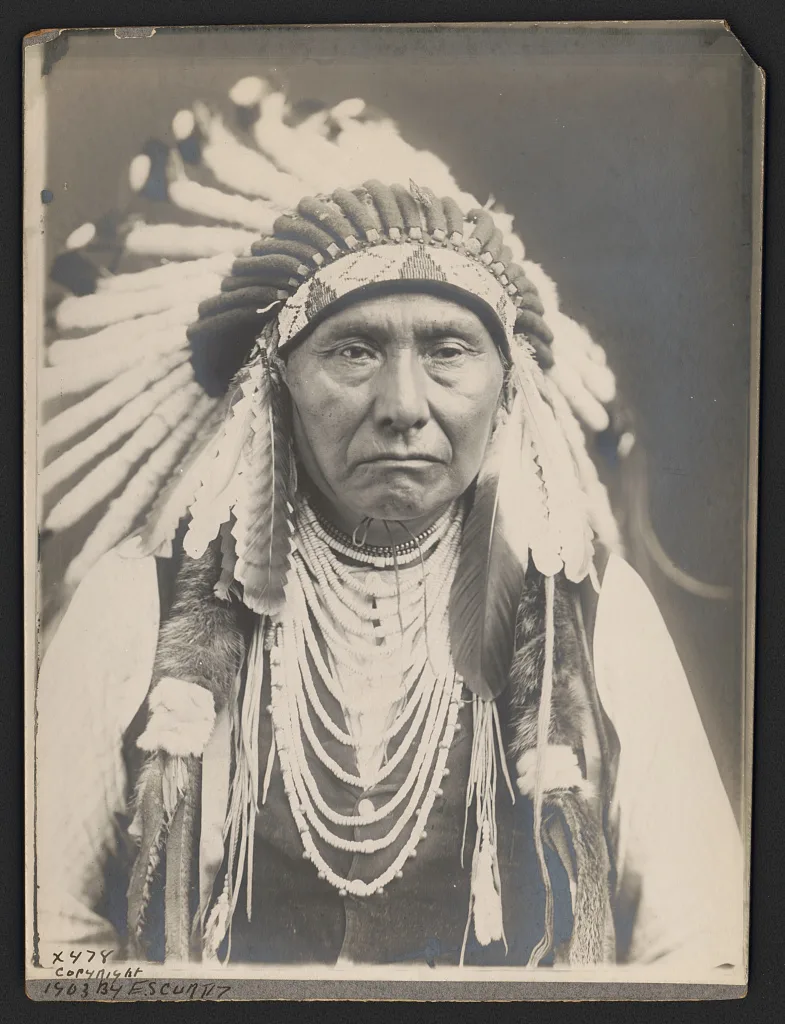
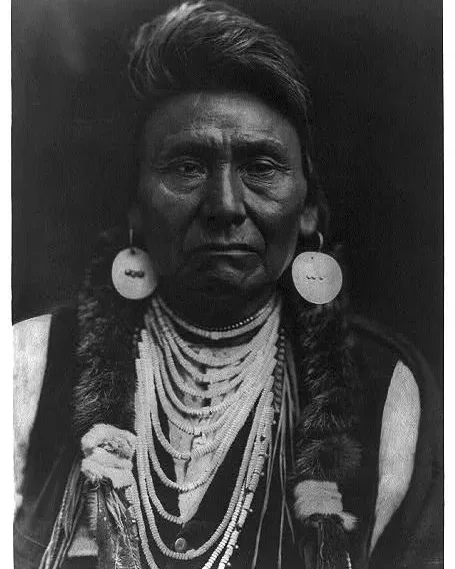
In November 1903 the Nez Perce leader Joseph, then about sixty-three and living in exile on the Colville Reservation, visited Seattle to plead for his people's return to the Wallowa Valley, and Edward S. Curtis photographed him in his studio. Joseph died the next year. This archive holds two of the resulting portraits: a print of Joseph in a feathered war bonnet and the bareheaded photogravure published as plate 256 of The North American Indian.
- Sitter
- Joseph (Heinmot Tooyalakekt, also written In-mut-too-yah-lat-tat, "Thunder Rolling in the Mountains"), leader of the Wallowa band of Nez Perce
- Date
- 1903 (copyright 1903; Curtis negative no. 478 for the war-bonnet portrait)
- Place
- Curtis's studio, Seattle, during Joseph's visit of November 1903
- Published
- The North American Indian, Volume 8 (text illustration) and Portfolio VIII, plate 256 (1911)
- This archive's prints
- Gelatin silver print on mount, 22 x 16.3 cm (war bonnet), and the plate 256 photogravure, both Library of Congress
- Also known as
- Chief Joseph; Chief Joseph—Nez Percé; Chief Joseph photograph; Edward Curtis Chief Joseph
Who Joseph was
Joseph was born around 1840 in the Wallowa country of northeastern Oregon and led the Wallowa band of the Nez Perce after the death of his father, Tuekakas, known to whites as Old Joseph, in 1871. His Nez Perce name is written in several ways, among them Heinmot Tooyalakekt, and is translated as Thunder Rolling in the Mountains; the name Joseph was given to him by the missionary Henry Spalding.
In 1877, during the Nez Perce War, Joseph's people fled from Idaho toward northern Montana with federal troops in pursuit. He surrendered on October 5, 1877, near the Bear Paw Mountains, close to the Canadian border, with the words recorded as "From where the sun now stands I will fight no more forever." The band was sent into exile in Indian Territory, in present-day Oklahoma, and in 1885 Joseph and about 150 of his people were moved to the Colville Reservation in north-central Washington, still far from the Wallowa. He spent the rest of his life campaigning to return.
The Seattle sitting
In November 1903 Joseph came to Seattle at the invitation of Edmond Meany, a University of Washington professor who had written about him and had met him at Nespelem in 1901. Traveling with his nephew Red Thunder and a former federal Indian agent, Henry Steele, Joseph arrived on November 19 and stayed four days. He watched a university football game, spoke to students, and addressed an audience at the Seattle Theater, where he again asked to go home. During the visit Curtis photographed him at his studio.
The Library of Congress print in this archive carries Curtis's copyright notice for 1903 and his negative number 478, which fits that visit. Joseph died at Nespelem on the Colville Reservation in September 1904, less than a year later. His doctor said he had died of a broken heart. Curtis attended the memorial potlatch held for Joseph at Nespelem the following summer, and the archive also holds a separate 1905 photograph titled Joseph Dead Feast Lodge—Nez Percé.
Two portraits
The two images in this archive are different poses, not two prints of the same picture. In the gelatin silver print, Joseph faces the camera in a feathered war bonnet, with many strands of necklaces over his chest; the Library describes it as a half-length portrait. Curtis used this image as an illustration in the text of Volume 8 of The North American Indian.
The better-known portrait is the photogravure published as plate 256 of Portfolio VIII in 1911. Here Joseph is bareheaded, his hair swept up from the forehead, wearing large round ear ornaments and the same kind of layered necklaces, against a dark background. Impressions of the plate are inscribed as printed by John Andrew & Son and as made "From Copyright Photograph 1903."
Why the portrait became famous
Joseph was already a national figure when Curtis photographed him, known from the 1877 war and from speeches such as the one he gave in Washington, D.C., in January 1879. Curtis's caption for plate 256 opens by saying that Joseph's name was better known than that of any other Northwestern Indian, and it is unusually direct about the injustice done to the Nez Perce, calling their effort "to retain what was rightly their own" an unparalleled story of resistance.
The close framing and steady, unsmiling gaze give the picture its weight. Unlike many Curtis plates, it shows a named, historically documented person photographed at a known time and place, and it was made in the last year of his life, which has added to its reputation as a final record.
What to look for
In the war-bonnet print, look at the lower left corner, where Curtis's number, copyright line and date are written on the negative. Compare the way the bonnet's feathers frame the face with the plainer setting of the photogravure, where the dark background and side lighting concentrate attention on Joseph's face and the texture of his hair and necklaces. In both, the camera is level with his eyes, a choice that gives the sitter authority rather than reducing him to a type.
Regalia in Curtis portraits was sometimes chosen by the photographer, and studio portraits of this kind were arranged sittings, not candid pictures. Neither source on this sitting says who chose what Joseph wore, so it is best to read the clothing as what he wore for the camera that day rather than as everyday dress.
The versions in this archive
The main image is the Library of Congress gelatin silver print titled Joseph—Nez Percé, mounted on a card about 22 by 16.3 centimeters, with Curtis's 1903 copyright and negative no. 478. The second is the Library's photogravure of plate 256, catalogued as [Chief Joseph - Nez Perce, head and shoulders, facing front]; its record notes that it is old caption-card data and gives no date, but museum impressions of the same plate are inscribed with the 1903 copyright and the plate was published in 1911.
Other versions in the archive
Frequently asked questions
When did Edward Curtis photograph Chief Joseph?
In 1903. Joseph visited Seattle for four days from November 19, 1903, and Curtis photographed him at his studio during that visit. The portraits carry a 1903 copyright date.
Where is the famous Chief Joseph photograph from?
The best-known version is plate 256 in Portfolio VIII of Curtis's The North American Indian, published in 1911. The Library of Congress also holds a 1903 print of Joseph wearing a war bonnet.
When did Chief Joseph die?
Joseph died at Nespelem on the Colville Reservation in Washington in September 1904, less than a year after Curtis photographed him. He is buried at Nespelem, not in the Wallowa Valley he hoped to return to.
What was Chief Joseph's Nez Perce name?
His name is written in several ways, including Heinmot Tooyalakekt and In-mut-too-yah-lat-tat, and is translated as Thunder Rolling in the Mountains.
Sources
- Joseph—Nez Percé, catalog record (Library of Congress)
- [Chief Joseph - Nez Perce, head and shoulders, facing front], catalog record (Library of Congress)
- Mossback's Northwest: When Chief Joseph came to Seattle (Cascade PBS)
- Chief Joseph (HistoryLink.org, essay 8975)
- Chief Joseph, exhibit guide (University of Pittsburgh Library System)
- Chief Joseph—Nez Percé, plate 256 (Nelson-Atkins Museum of Art)