In a Piegan Lodge (1910)
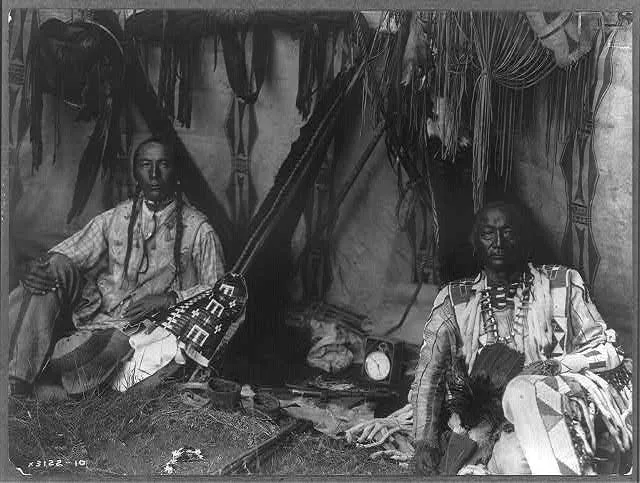
Little Plume and his son Yellow Kidney, Piegan (Blackfeet) men in Montana, sit on either side of a lodge interior with a pipe between them. When the picture was published as plate 188 of The North American Indian, a small clock on the ground between them had been removed, and the alteration has become the best-known example of Curtis editing modern life out of his pictures. Both prints in this archive are unretouched and still show the clock.
- Date
- 1910 per the Library of Congress (negative numbers end in -09 and -10); published 1911
- Sitters
- Little Plume and his son Yellow Kidney, Piegan (Blackfeet)
- Place
- Montana
- Published
- The North American Indian, Volume 6 portfolio, plate 188 (1911), with the clock removed
- This archive's prints
- Two Library of Congress photographic prints, Curtis negative nos. 3088-09 and 3122-10, both showing the clock
- Also known as
- Piegan Lodge; Little Plume and Yellow Kidney; Edward Curtis clock photograph
What the photograph shows
Two men sit on the grass-covered floor of a lodge, one on each side of the frame, facing the camera. The Library of Congress identifies them as Little Plume and his son Yellow Kidney, Piegan men, and describes a pipe between them. Behind them hang the lodge lining, painted and decorated, along with fringed bags and other belongings, and a lodge pole runs diagonally through the center of the picture with a beaded bag hanging from it. The space is dim, lit from the side, with the men's faces and clothing picked out against the dark interior.
The Piegan are one of the Blackfeet peoples of Montana.
The clock
On the ground between the two men, next to the man on the right, sits a round alarm clock in a small case. In the version Curtis published as plate 188 of the Volume 6 portfolio in 1911, the clock is gone. The artist and scholar Ken Gonzales-Day describes the original as showing a small, round and very modern alarm clock, and notes that in the photogravure its removal left a strange round blur just to the left of the right-hand man's elbow. The Smithsonian Institution Libraries uses the two versions side by side to illustrate Curtis's working method.
The writer Gerald Vizenor calls the retouching a crude removal made to preserve an illusion of traditional authority, and argues that the picture with the clock is the more interesting one. Gonzales-Day goes further, calling such alterations a kind of violence because they undermine the photograph's claim to show what was there.
How the change was made
Curtis's photogravures were not prints from the negative itself. According to the Smithsonian Institution Libraries, Curtis made a series of work prints for each image to guide the production of the final gravure, and sometimes annotated them with instructions for the studio's craftsmen, including removing parts of the picture that showed signs of Western civilization such as a car or a group of tourists. Gonzales-Day explains that the image on the glass negative was transferred by hand to a copper printing plate, and it was at this stage that the clock was taken out.
The Smithsonian notes that this kind of alteration was widely accepted in photography's early years. What makes this case notorious is that the object removed was not a blemish but evidence of how Little Plume and Yellow Kidney actually lived.
Why it became famous
In a Piegan Lodge is now cited less as a portrait than as evidence. It is the example most often used to show that The North American Indian presented a constructed past. Vizenor places it alongside Curtis's other practices: paying people to pose, choosing costumes and ornaments, staging ceremonies out of season, and removing parasols, suspenders, wagons and other modern things from his pictures. The clock is a small object, but it shows that Little Plume's household kept a modern timepiece, an everyday fact that Curtis's idea of a vanishing race could not accommodate.
What to look for
Find the clock first. It sits on the ground between the two men, just in front of the man on the right, its white face clearly visible inside a small dark case. Once you have seen it, look at the area around it in the published plate if you can find a reproduction, and the blurred patch where it was removed becomes easy to spot.
Then look at the rest of the lodge. The lining behind the men is painted with geometric designs, fringed bags and other belongings hang from the poles, and a beaded bag hangs from the diagonal lodge pole in the center. The floor is covered with grass or hay. The man on the left wears a checked shirt and long braids, and the man on the right wears layered necklaces and a decorated garment. These are the details Curtis wanted his readers to see, and the clock sits among them as naturally as everything else.
The versions in this archive
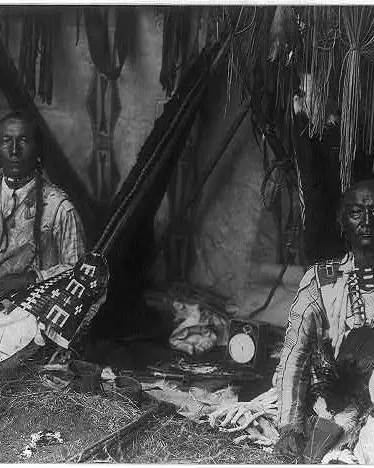
This archive holds two Library of Congress photographic prints of the scene, both titled In a Piegan lodge and both linked by the Library to plate 188. They come from two separate negatives, numbered 3088-09 and 3122-10 in the lower left corners, with separate copyright registrations, and the poses differ slightly: compare the positions of the men's hands and the angle of the left-hand man's head. In both, the clock is plainly visible on the ground between the two men, so these are the unretouched versions. The Library dates both to 1910; the Smithsonian gives 1911, the year the plate was published.
Other versions in the archive
Frequently asked questions
What was removed from In a Piegan Lodge?
An alarm clock that sat on the ground between Little Plume and Yellow Kidney. It was removed when the image was made into the photogravure published as plate 188 of The North American Indian in 1911.
Why did Edward Curtis remove the clock?
Scholars agree that the clock was a sign of modern life that did not fit Curtis's picture of a timeless, traditional past. The Smithsonian notes that Curtis routinely had signs of Western civilization removed from his images.
Who is in In a Piegan Lodge?
The Library of Congress identifies the two men as Little Plume and his son Yellow Kidney, Piegan (Blackfeet) men photographed in Montana.
Does this archive's version show the clock?
Yes. Both Library of Congress prints in this archive are made from Curtis's original negatives, numbered 3088-09 and 3122-10, and both show the clock.
Sources
- In a Piegan lodge, print from negative 3122-10, catalog record (Library of Congress)
- In a Piegan lodge, print from negative 3088-09, catalog record (Library of Congress)
- Curtis' Technique: Prints, Tools for Creating the Final Product (Smithsonian Institution Libraries)
- Ken Gonzales-Day, In a Piegan Lodge (Performing Archive: Curtis + the vanishing race, Scalar)
- Gerald Vizenor, Edward Curtis: Pictorialist and Ethnographic Adventurist (Library of Congress American Memory essay, 2000; archived copy)
- Montana's Indian Country (Lewis and Clark Fort Mandan Foundation)